Thursday, November 13, 2014

Blog # 3: The Climate and Weather of Rio de Janeiro, Brazil

A Valley type fog in Rio de Janeiro
http://famouswonders.com/christ-the-redeemer-statue-on-corcovado-mountain/
CLIMATE & WEATHER:

When a random person wants to travel the globe and visit places around the world. Warm climates come to mind. Meaning the place they are going to visit will be nice and hot. Perhaps tropical. You know, where you can have a pina colada and just relax on the beach with your swimsuit on. Or going to explore and take wonderful pictures. Good thing that one of the greatest world hotspots falls on this list and is also a wonderful place to vacation. You know which world city i'm talking about. None other than Rio de Janeiro, Brazil.
Lightning strike on top of the Christo Statue in Rio
http://www.dailymail.co.uk/news/article-2543588/Construction-workers-dangle-100-ft-ground-begin-repair-work-Rio-Janeiros-famous-Christ-statue-damaged-recent-lightning-storms.html

Rio has the climate where its surroundings are the Amazon Rainforest, so yes the weather is tropical, hot, humid, and muggy. We have all heard the term three in one, meaning there are three types in one place. According to the Koeppen Scale, In Rio there are three types of climate that all apply to the city. Rainforest due to the Amazon surrounding most of Brazil, including Rio which creates rain storms year round. There is Monsoon type weather pounding Rio with intense precipitation. Most likely because of the location being next to the Atlantic Ocean. And during hurricane season weather along costal places intensifies. However, Rio is also considered being a Savanna type because it has wet and dry conditions for the summer and winter months. In my opinion, I believe that Rio has a convection type of (Latent Heat) because the majority of the heat is stored in the air with water vapor. Making it really humid and muggy.

Reference: (Class Lecture): Earth's Temperatures
This is a temperature graph of Rio for the months of January-December
http://en.climate-data.org/location/853/ 

Rio's weather is mostly rainy and tropical making December through March the months of most rainfall. more than average. in the summer temperatures can be as high as 104 degrees F* and into the low 60s for its lowest. The cold fronts from Antarctica that push north towards Brazil cause a lot of landslides, floods, extreme rain showers and lots of hail storms. year round the temperatures are pleasant enough for people to want to visit.

Reference: http://www.riodejaneiro.com/blog/2012/10/22/rio-de-janeiro-climate/
This is a climate graph of Rio for the months of January-December
http://en.climate-data.org/location/853/
Because Brazil is 90% tropical, in Rio, the southern part of the country you can experience 2 seasons. Wet and dry. Wet in the summer and dry in the winter The seasons in brazil are reversed because its in the southern hemisphere. Winter is June-September. Summer is December-March.

Reference:  http://www.unique-southamerica-travel-experience.com/climate-of-brazil.html

Average Rainfall - Rio de Janeiro

JanFebMarAprMayJunJulAugSepOctNovDec10101010101010101010101015111291168913131414Average rainfall, Jul, 10Average rainfallAverage rain days
  •  

Tuesday, October 14, 2014

Blog #2

Landslides: very common in Rio de Janeiro, Brazil
http://s2.dmcdn.net/bP11/x240-8pi.jpg
Mass Wasting In Rio:
    In the last unit sections of class lectures, we talked about rock decays and weathering and how hydrology changes everything in the environment. The most common activity in Rio de Janeiro, Brazil are landslides. The key to landslides and all of the downslope movement of angular slope material is gravity. Gravity and landslides are rapid forms of mass wasting. Any object on earth's surface involves gravity. The type of mass wasting most common in Rio is an avalanche style fall. Normally when we see the word avalanche we think snow. But the term avalanche really means a rapid down flow of any type of object. Debris, rocks, mudflow. It basically means a change in flow that incorporates colluvium.
Historic Landslide in Rio during the 1980s
http://pubs.usgs.gov/of/2001/ofr-01-0276/images/Fig26tn.jpg

    Massive landslides are usually triggered by certain movement. Earthquakes, faults moving or plates moving also. There is a South American plate or fault, but it does not get much activity on the Brazilian side. Mostly on the Pacific Ocean side, where Chile is. The landslides that occur in Rio de Janeiro, Brazil are because of the Serra do Mar, a coast range that goes all the way to the south eastern tip of Brazil. This is what features the famous sugar-loaves. the Serra do Mar gets triggered by intense summer rain storms. And because Rio is surrounded by hill slopes, water mixed in with the soil causes movements. The water bleeds through the soil causing the landscapes to move and landslides to occur. and these soil steep hill slopes are occupied a lot by the favelas in Rio. In Rio the most common slopes are colluvial mantle and is composed of 40% clay, in thick sand. This is a common trigger for movement in the soil, resulting in the landslides. Experiments and studies support and confirm that this occurs often in Rio and it is a major problem for the city, and people who live in the favelas.
A landslide in the favelas in Rio de Janeiro
http://i.telegraph.co.uk/multimedia/archive/01553/landslide_1553760i.jpg

     Volcanic Activity in Rio?? True or Not??
    There is a volcano in Rio, that is debated a lot. The Nova Iguacu "Volcano". Some support that it is an actual volcano some think it's not. Although it's characteristics are there. It has a cone shaped crater and appears to have forms form lava flow. Although it has never been proved. The features say it's a volcano but it has never been proved. The Nova Iguacu "Volcano" It's very famous to visit today, when you go to Rio.
The Nova Iguacu Volcano/Mountain in Rio de Janeiro, Brazil
http://www.skyscrapercity.com/showthread.php?t=1493434


 Refrences:
duff.ess.washington.edu/grg/publications/pdfs/fernandes_et_al.pdf
https:www.scribd.com/mobile/doc/141800150
Class Lectures: Volcanic Forms, Mass Wasting & Infiltration, Soils


Tuesday, September 16, 2014

The Rocks of Rio: Shapes and Decays

ROCKS, SHAPES & SIZES:
All rocks on earth change according to their environment. Where it's located. What is the climate. Is it hot, cold, humid and what makes the rocks change. How do the rocks get shaped. what makes the shape. Location and climate have a lot to do with the rock formation where the observation is taking place. Since Rio de Janeiro, Brazil is located in South America, the weather is really hot, and humid. There is beach and mountains that are different sizes. the rocks, rock formation, mountain shape are based on three types of rock. igneous rock which is crystalized and has magma. sedimentary rock, which has layers and strata striations and metamorphic being the last one. Metamorphic rocks are rocks that change its size or shape due to heat and pressure. It's an overall change. In Rio de Janeiro, the majority of rock consists of metamorphosed granite. The combining forces in its region make these steep mountains metamorphic.
A steep mountain consisting the metamorphic rock with granite. the rock is exposed due to combo fractures, climate and weather decaying.
http://exploringthearth.files.wordpress.com/2013/01/christ-the-redeemer-in-rio-de-janerio-brazil-1.jpg 
 When south america and africa split and became two different continents the rocks created weak fractures and minerals reacted to the granite, (the main mineral in Rio's rocks) it created a tropical chemical weathering, and the hot weather in Rio formed what is called sugarloaf-domes all over rio. the domes are caused by exfoliation sheets. This helps the environment around Rio de Janiero to maintain its rainforest, a rainforest.
process of rock weathering
http://www.oocities.org/sg/c_pling/rockcycle.gif
an example of a sugarloaf-dome rock formation in one of Rio's national Parks
http://0.tqn.com/y/climbing/1/L/D/J/-/-/Rio_Sugarloaf_PhGuenterFischer_Getty_3.jpg 
One of the hot spots to visit while in Rio is Arpoador Beach. which is combining two beaches and two parks by one rock formation. The rock is Arpoador stone that comes out form the ocean directly. It's shape and size is unique because its smooth and shaped in a way where you can do activities while on top of the rock. like a very popular one for centuries. Whale hunting with harpoons  
picture of Arpoador Park/beach featuring the "pedra do Arpoador(Arpoador rock) combining two parks and two beaches together.
http://www.visitriodejaneirobrasil.com/arpoador_rock.jpg  

Refrences:
www.rentanapartmentinrio.com/arpoadordiabobeach.html 
www.exploringthearth.com/2013/01/12/rise-in-rio/
Class Lecture: earths innards


Sunday, August 31, 2014

Rio de Janeiro, Brazil at sunset

Introduction Blog:

Blog created by Joel Medina:

Hello everyone and welcome to my awesome blog on physical geography of Rio de Janeiro, Brazil. First let me introduce myself. My name is Joel Medina and I am currently a student at the University of Colorado Denver or as others call it (UCD). I have lived in Denver, Colorado all of my life. I really enjoy traveling and visiting other places. It helps me enjoy it, and relax while taking my mind off thoughts and anything else going on in a college students mind. I have set up this blog to look closely at a worldwide hotspot Rio de Janeiro, Brazil.  

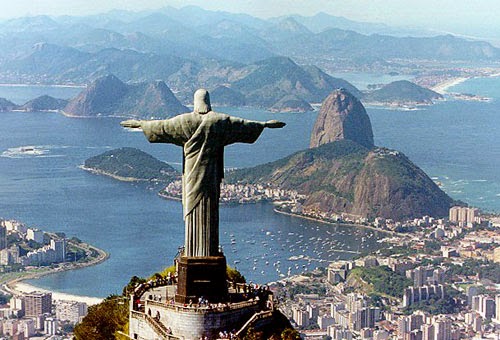
This is the famous statue of Christ on a nearby mountaintop overlooking the city
   
I have chosen Rio de Janeiro, Brazil because it's beautiful there and full of culture. You can enjoy the beach and the mountains in the same city limits. And because of amazing photographs of Rio, all over the world, I can tell there is a lot of geography to look at and do a hands on study. I also chose this worldwide hotspot because Fast Five was filmed there. One of my favorite movies in the Fast and Furious franchise. And also this summer Rio hosted the 2014 FIFA World Cup. And being a huge soccer fan, I really enjoyed watching all of the world cup games because I could see a geographic and   culture perspective. I think studying the physical surroundings of Rio de Janeiro, can really show me a lot of geography to only make me want to travel there in the near future. So join me in this incredible adventure and thank you for following this blog. We will have lots of fun, this semester.

References for pictures top to bottom:  

http://www.guesttoguest.com/blog/wp-content/uploads/2013/11/rio-de-janeiro.jpeg

http://blogimgs.only-apartments.com/images/only-apartments/6418/visit-rio-de-janeiro.jpg